
Episode 54: Private Equity Playbook - Tony's Chocolonely
Tony’s Chocolonely built a global brand on a promise to end exploitation in cocoa. That promise helped sell a lot of chocolate. It also gave private equity something to buy into. In this episode of the Private Equity Playbook, Manpreet Kaur Kalra and Anna Canning follow the money behind those brightly wrapped chocolate bars, from a Dutch television stunt to supermarket shelves around the world – Tony’s has grown massively with private equity firm Verlinvest as the majority owner.
A reputation for “doing good” attracts customers and capital. The mission becomes a commercial asset – something investors can buy into and profit from. — Manpreet Kaur Kalra
We trace the story from the colonial roots of the cocoa trade to the decisions that shape it today. Tony’s says that they are changing the industry from within by working with Barry Callebaut, one of the world’s largest chocolate processors that also happens to have a rap sheet filled with human rights violations of child labor and forced labor. But how possible is that change when shareholders define success by growth and profitability? We look at what that growth actually delivers for farmers and how much power they actually have in defining how the business upholds its mission to end exploitation.
In this episode, we explore:
The very real human rights climate of cocoa farming
How a Dutch journalist (Tony) became the face of a fight cocoa farmers were already waging
Why cocoa prices can soar while farmers still struggle to make a living, and how the terms that brands buy on shape what farmers take home
What decades of voluntary industry commitments have delivered, from the Harkin–Engel Protocol to the systems companies use to track and respond to child labor (spoiler alert: a whole lot of fancy impact reports)
The history of Barry Callebaut, one of the largest cocoa processors
How private equity firm Verlinvest’s family-backed capital works and the complex web of investors and entrepreneurs whose names show up every time you scratch the surface of a sleek-branded, mission-forward business
The pitfalls of Tony’s Mission Lock model, and whose interests it omits
Tune in as we ask how much power a company is willing to let go off and share with the people growing its cocoa when it promises to change the industry in their name.
How did Tony’s Chocolonely get its start?
Tony’s began in 2005 after Dutch journalist Teun van de Keuken reported himself to the police as a “chocolate criminal” because he ate chocolate that he believed was produced using “slave labor.” The stunt was part of a television investigation that led to a one-off run of 5,000 Fair Trade chocolate bars. The bars sold, and a television sketch became a business synonymous with the promise “100% slave free.”
Corporations are continuing to make tweaks around the edges instead of addressing a business model that’s still fundamentally based on exploitation.
— Anna Canning
Is Tony’s Chocolonely 100% slave free?
No. Tony’s uses “100% slave free” to describe a goal for the chocolate industry. This stems from just how much Tony’s uses the phrase 100% slave free, but when you read closer, you realize they are saying that they are aspiring towards 100% slave free chocolate, not that their chocolate is currently 100% slave free. So, on the wrapper, it can sound like a guarantee about the bar in your hand. However, over the years, Tony’s has quietly changed it’s popular slogan to be more focused on the broader issue of exploitation of cocoa.
The chocolate industry is built on a model of free and ultra-undervalued labor. — Anna Canning
In its 2024/25 reporting, Tony’s said it identified 3,448 cases of child labor. Child labor and forced labor can overlap, and this figure counts cases of child labor. As we discuss in the episode, broader monitoring can bring more cases to light. The test is what happens next. And when a company makes bold claims like this, we have to ask how this is tangibly possibly while still operating within the existing system of exploitation within the industry (aka: working with Barry Callebaut).
What is the Harkin–Engel Protocol?
The Harkin–Engel Protocol was a voluntary agreement reached in 2001 under which major chocolate companies pledged to work toward eliminating the worst forms of child labor in cocoa production.
In the late ’90s and early 2000s, a series of journalistic exposés revealed widespread child labor in the West African cocoa industry. The public outrage was enough to push Congress toward binding legislation. Then the cocoa company lobbyists swarmed and what we ended up with was a promise from big names like Nestlé, Mars, Hershey, and Cargill to self-regulate. No new laws needed, they said. They’d take care of it themselves. The original 2005 deadline came and went, and the industry kept pushing its deadlines back. And still, 25 years later, the goal of eliminating the worst forms of child labor in cocoa hasn’t been met.
Who owns Tony’s Chocolonely?
Tony’s has a portfolio of investors including former Starbucks Chairman and CEO Howard Schultz. However, significant ownership sits with two primary players: the private equity firm Verlinvest and venture firm, JamJar.
Verlinvest and JamJar first invested in Tony’s in 2020. In 2023, Tony’s announced another funding round from existing shareholders. Verlinvest already controlled a majority of voting rights, and the new round gave it a majority of total shares as well. JamJar also increased its stake.
What is “evergreen” private equity?
Verlinvest describes its capital as evergreen, meaning these funds don’t have a fixed end date and can keep operating over time. So say when the firm sells an investment, it can reinvest the proceeds into another business. It can also accept additional money over time. This gives the investors more flexibility around keeping the investment for longer if they think it will become more profitable.
Impact does not scale like a business. — Manpreet Kaur Kalra
Verlinvest describes its family-backed capital as evergreen and says this allows it to invest from a company’s early stages through a stock-market listing and beyond. Now, sure that means the time pressure of a traditional PE firm is not as pressing, but the expectation around exponential growth and big returns remains.
Why does Tony’s work with Barry Callebaut?
Barry Callebaut has processed cocoa for Tony’s since its early days. Tony’s says its cocoa is kept separate during processing and that working with a major processor shows traceable sourcing can work at industrial scale. In 2026, Repórter Brasil reported that Brazilian labor courts had held Barry Callebaut’s Brazilian subsidiary liable for child labor and conditions analogous to slavery in its Brazilian cocoa supply chain.
The partnership raises a question we keep coming back to. Has Tony’s used its leverage to change how a major processor operates across its business? Or has a major processor given Tony’s the capacity to grow while the broader terms of the cocoa trade stay in place?
A commitment to human rights should shape how a business evaluates power throughout its commercial relationships, including the people it welcomes as investors and owners.
— Manpreet Kaur Kalra
What is Shareholder Primacy as opposed to Stakeholder Capitalism?
Shareholder primacy is the idea that a company exists primarily to create value for its shareholders. Workers and communities only matter if it benefits the bottom line of the company and the owners.
In the case of stakeholder capitalism, the idea is that a company has responsibilities to everyone affected by its business – from farmworkers to the communities impacted by the company’s operations. Basically, the thought is that communities have a legitimate interest in what a company does to their water, land, environment, health, etc, regardless of whether protecting those things increases profits.
Farmers and workers should have power to shape the solutions being proposed in their names. — Anna Canning
Private Equity Playbook
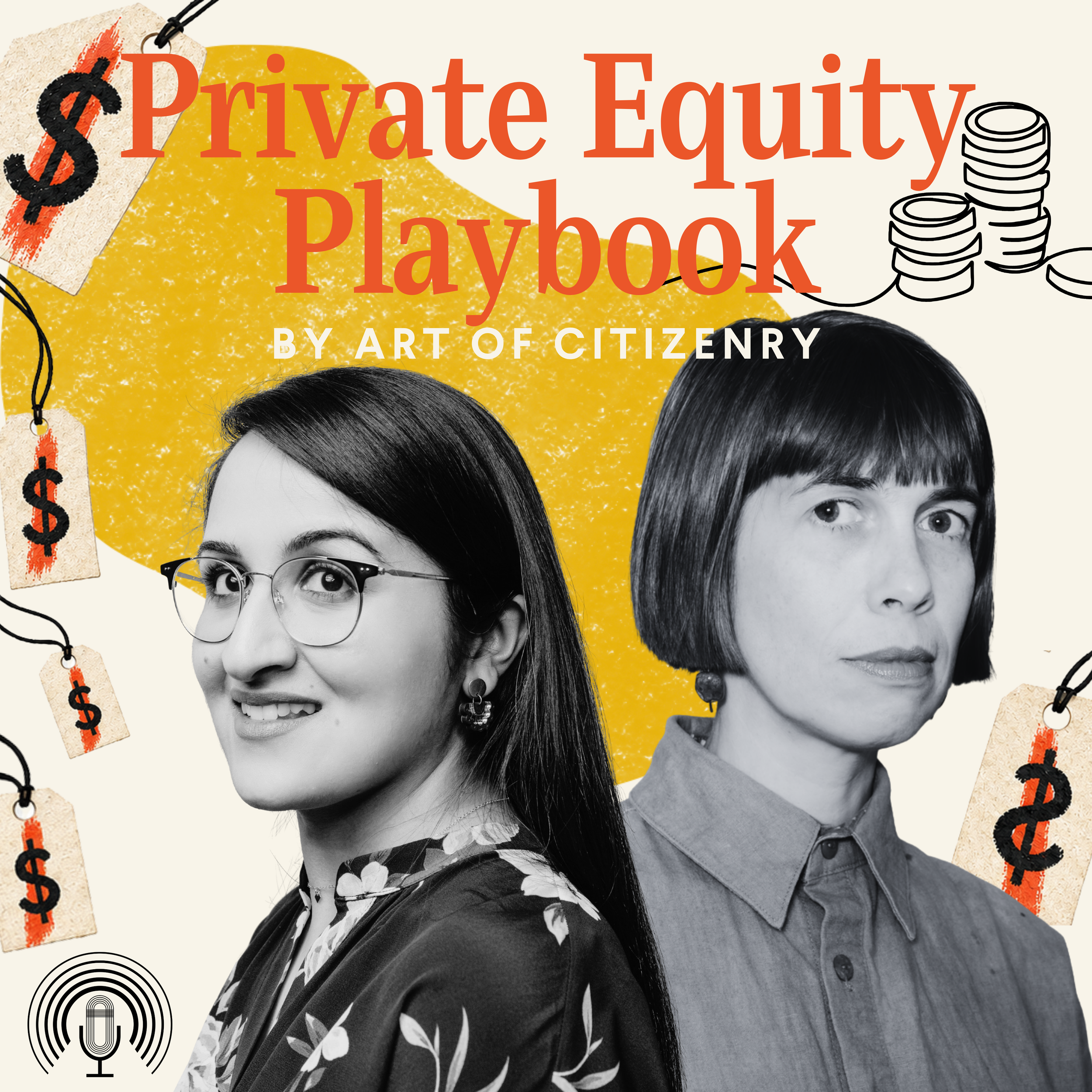
Private Equity Playbook is a series by Art of Citizenry that examines how private equity is reshaping our everyday lives. In each episode, host Manpreet Kaur Kalra and long-time collaborator Anna Canning, investigate private equity in another corner of everyday life, digging into where it’s headed and what that means for us.
🎧 Tune into other episodes in this series >>
Support the Podcast
Art of Citizenry is 100% listener-supported. Every contribution helps us continue producing research-intensive episodes and paying our small but mighty team. If this episode resonates with you, consider supporting our work:
Thank You for Listening
Please subscribe and leave a five-star review for Art of Citizenry wherever you listen to podcasts. Also, follow along and share your thoughts on Substack - artofcitizenry.substack.com.