
Episode 46: Decolonizing Economics
📌 Read along, scroll down for the full transcript!
We're taught to think of economics as an objective truth. But what if economics isn't neutral at all? What if it's a story shaped by power and by a history that has been carefully edited? A story that celebrates innovation and progress while quietly erasing extraction, exploitation, and the violence behind how wealth became concentrated geographically.
In this episode of Art of Citizenry Podcast, Manpreet Kaur Kalra speaks with economist Carolina Alves about colonialism, capitalism, development economics, and the Eurocentric foundations that continue to shape global economic policy today.
Together, they unpack how mainstream economics often separates markets from history, obscuring the role colonial extraction, slavery, and unequal trade played in building modern wealth. From informal labor markets to communal economic models rooted in reciprocity, this conversation challenges the idea that Eurocentric economic systems represent a universal path toward prosperity.
In this episode, we explore:
What it means to challenge the Eurocentric assumptions embedded within mainstream economic theory
Why GDP and economic growth became dominant measures of success
How development economics emerged during the decolonization era
Why many Global South economies remain structurally dependent within the global economic system
The tension between economic growth and inequality under capitalism and whether inequality is a flaw within capitalism or structurally embedded within it
“Decolonizing economics is about something more foundational than representation. It’s about repositioning the vantage point entirely.” – Carolina Alves
Further Reading
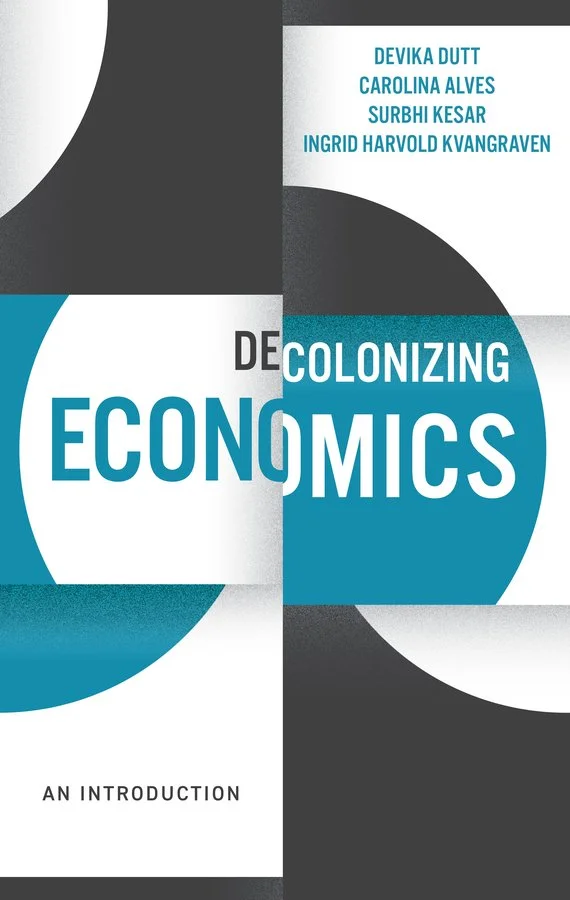
Decolonizing Economics: An Introduction by Devika Dutt, Carolina Alves, Surbhi Kesar, and Ingrid Harvold Kvangraven
Capital in the Twenty-First Century by Thomas Piketty
The Myth of Economic Development by Celso Furtado
📌 Art of Citizenry is proudly independent. Support us as we critically explore, challenge, and unravel mainstream narratives by empowering listeners with accessible, nuanced perspectives.
Make a one-time contribution via Paypal: visit.artofcitizenry.com/paypal
Meet Our Guest: Dr. Carolina Alves
Dr. Carolina Alves is Associate Professor in Economics at the Institute for Innovation and Public Purpose (IIPP) at University College London, and a Fellow in Economics at Girton College, University of Cambridge.
📖 Read: Episode Transcript
📌 Due to some audio quality challenges during the recording, we’ve included a full transcript to help listeners follow the conversation and engage with the ideas discussed in the episode — scroll down to read along!
Manpreet Kalra: Development economics has underpinned my work for over a decade now, shaping how I engage with fair trade, impact measurement and reporting, and sustainable international development, law. Across this work, I’ve operated at the intersection of globalization, business and human rights – examining not just how value is created within global supply chains, but how it is narrated, measured, and communicated. Because the stories we tell about impact often shape what we choose to see, how we choose to define growth, development, progress, and what we allow to remain invisible.
And so, when I came across Carolina and her co-author’s book “Decolonizing Economics: An Introduction,” I knew this was a conversation I could not turn away from having on the podcast.
Carolina Alves: I work intentionally across different disciplines — such as development studies, political economy, and sociology — to try to understand how global financial structures are shaped by our relations and long-standing historical legacies that then, of course, influence economic outcomes, particularly in my research in developing countries. I examine how fiscal and monetary policy interact with financial mobilization in the constant development of the international monetary and financial order. But a key contribution in that context is to understand the pressures — or, let's say, the conflicting pressures — that developing countries face, because they're pursuing growth, they're pursuing stability, they want to meet social needs, but they are fundamentally operating within a global financial system that is marked by hierarchy, volatility, and unequal relations. So my research tries to consider those structural constraints at its core, and therefore I challenge the mainstream narratives that present macroeconomic policy as neutral.
Manpreet Kalra: Right in the middle of the central plaza in Edinburgh, Scotland, one of the wealthiest cities built on the back of the British Empire, stands a tall statue of Adam Smith. Commonly referred to as the father of economics, his theory of the invisible hand, the idea that free markets in which people participate in their own self-interest or are left to their own devices, inadvertently serve the greater social good, has become a cornerstone of modern capitalism.
Economics, as a discipline, was built on a few core assumptions: that people are rational actors, that innovation flourishes when it's incentivization, and that growth is both the goal and the measure of a healthy society.
But, as we will continue to explore, economics is not a neutral expertise; it is shaped by the histories that’ve produced the global economy as we know it today. So let's start with the foundations of economics as a discipline.
What role did colonial power structures play in the creation of economic theory as we know it today?
Carolina Alves: Yeah, I mean, this is a great question — and a difficult one for economics, which it shouldn't be, because economics is a social science, and we know many other social sciences have been discussing the role of colonial power systems in their knowledge production. And economics has managed to kind of protect itself.
I would say that the reason why this question is so important is because we are in a historical moment where talking about decolonization is becoming mainstream. So it's important to be really clear about what you mean — whether or not the discipline has been colonized or has been shaped by colonial powers in the first place. So the question is actually one that I didn't start this discussion with, but it's definitely the one that, with time, became central.
So when you talk about the discipline's official origins or official history, we always have to think about Adam Smith — the father of economics. But it's very interesting to understand that economics as a discipline today is based on a very selective and idealized reading of Adam Smith's work. What that means is that economics took a small part of his economic ideas — such as the invisible hand — and built a model where we're talking about markets and human beings being rational, or markets having self-correcting forces that are universal. In this version, the discussion of capitalism is kind of sidelined. Not only do we very often see capitalism as synonymous with markets, but capitalism is framed as something that emerged naturally through the process of innovation and rationality. So the Enlightenment comes in — that's the moment when Adam Smith is writing.
But what is really interesting in that narrative is that we don't include in the discussion the role of colonialism, imperialism, and the transatlantic slave trade. So we have what we call a very Eurocentric field of history — one that erases violations, extractions, expropriations, and so on.
What is Eurocentrism?
Carolina Alves: Eurocentrism is a worldview that treats Western Europe’s historical experience as universal. That’s the pathway we all have to follow. It’s the narrative that presents capitalism as something that emerged organically, peacefully, rationally — the best way to organize society.
And this Eurocentric narrative minimizes events that are not peripheral, such as colonialism and the transatlantic slave trade, where we could look at the accumulation of wealth in Europe and the impoverishment of colonized regions in a very different way if we consider that history is much broader than that.
Manpreet Kalra: Maybe this is just my understanding, but it seems like in the mainstream consciousness or understanding of economics, capitalism just appears. It appears as innovation, rationality, progress — as a tool of development. But capitalism did not emerge in a vacuum. What's edited out of that narrative are the systems that made that wealth accumulation possible. It accelerated during the era of colonial expansion: stolen land, enslaved labor, theft of land and resources at a global scale, trade routes enforced by gunships, and policies written to benefit the metropole at the expense of the colony. Colonial plunder provided the raw materials, wealth, and slave labor that fueled capital accumulation in Europe. These aren't footnotes in economic history — they are its foundation. The so-called free market was truly never free. It was structured to benefit those who held the power to set the rules.
And yet, somewhere along the way, economics positioned itself as a neutral science — objective and universal. Economics, nonetheless, has been purposefully divorced from history. Colonialism, imperialism, and the neo-colonial economic policies that continue to maintain systems of control — from structural adjustment programs to trade liberalization to austerity measures — economics doesn't exist outside of history. In fact, history shaped the way our global economic system was structured and continues to function. And so when a discipline builds models divorced from historical context, it feels like it is destined to build models that allow for inequality to exist at a global scale. At a more tangible level, how have you seen the purposeful separation of history from economics further nurture global inequalities?
What happens when economics is separated from history?
Carolina Alves: You're so right to make that point. History has become a little bit more accepted in economics — not only history, but history of economic thought. We know history is a narrative of power. History is told to us from the perspective of those who won. So we have to be very careful, when we're looking back at history or taking a historical approach in our research, about which history we are really talking about.
Of course, when we separate history from economics, what happens with global inequalities? This is a very pertinent question for our historical moment — not only because inequality has of course been increasing, but because inequality as a topic of study has become more common in economics. Since the publication of Piketty's Capital, the profession has had to say, "Oh my gosh, we have to deal with inequality." And I think there is this question of global inequality — when you're looking at history from both the empirical and the Eurocentric perspective — in which you're actually trying to understand the development of capitalism. And the question becomes: is inequality part of that history?
Manpreet Kalra: In 2013, French economist Thomas Piketty published Capital in the Twenty-First Century which, using data, made the case that inequality isn't a bug in capitalism. It's a feature. His central finding was essentially that when the rate of return on capital constantly outpaces economic growth (which, historically, it does) wealth concentrates. The rich don't just stay rich, they get richer. They pull further ahead and the gap widens. Picketty’s book put inequality back at the center of mainstream economic conversation.
But, there is tension here as well. Piketty used data primarily drawn from Western Europe and the United States. He frames inequality within wealthy nations. And what largely goes unexamined is how those wealthy nations got their wealth in the first place. The colonial transfer of resources, the centuries of uncompensated labor, the deliberate underdevelopment of the Global South. And I suppose, as I have brought up many times on this podcast and in my work, the global north-global south divide, in and of itself, is laced with colonial power dynamics.
“Heterodox economics” refers to alternative economic theories that emphasize social constraints, power dynamics, and historical context. How should we be thinking about inequality?
Carolina Alves: I say to my students that Piketty — all this amazing work on inequality that comes from him — is still able to be received at top universities in the US because he's not challenging the professional core. He's not challenging the methodology. He's not challenging the theory. If you're taking this approach to history and trying to understand the economy in embedded society — which is what many of the so-called heterodox economists actually do — you're engaging with this historical process itself. It is a process of social provisioning. It is about the structure of production and reproduction in society. So you have to talk about markets, about labor, about distribution. From that perspective, I think when we're discussing the separation of history from economics in terms of how we can deal with or understand inequality, we are still far from having more answers — not just about documenting inequality, but about resolving this debate, which may never truly be resolved: whether inequality is a feature of capitalism or not.
Manpreet Kalra: We tend to treat inequality as a problem that economies can solve. After all, that is the foundational assumption of development economics — a field premised on the assumption that we can all "grow ourselves out of poverty" through capital and trade. What we overlook is that development economics — a model that has underpinned the fair trade movement, impact investing, microfinance, the Sustainable Development Goals, structural adjustment programs, foreign aid, and more — is a field that emerged not coincidentally during the decolonization era, as European colonial powers were beginning to relinquish formal control over territories.
The premise was tidy. Poor countries weren't poor because they had been systematically extracted from. They were poor because they hadn't yet developed. The solution wasn't reparations or redistribution — it was trade. Unequal trade became a colonial continuation, with development economists focused on integrating previously colonized countries into the very global economic system that had impoverished them in the first place.
Now, "decolonization" as a term gets tossed around a lot. I just used it, and I used it to refer to that formal period of time when colonial rule began to dismantle. It also gets used as an objective within present-day discourse.
How do you define what decolonization means in the context of economics? And maybe more importantly, what is it not?
Carolina Alves: Decolonization is part of understanding society with all its history — the positives and the negatives, and the legacies we still carry. Economics is one of the main sciences resisting this. I'm avoiding giving you a definition because we've also come to realize that it's a process more than anything else. One thing there was some agreement on — if I can put it that way — is what decolonization is not.
Very often, when you bring up the discussion of decolonizing economics, everybody thinks we're talking about race and racism. That's certainly part of the discussion. But as we discuss the Eurocentric dimension of economics more, we want to make the agenda of decolonizing economics much broader.
Manpreet Kalra: Decolonization is not a destination you arrive at. It's a practice. A continuous, often uncomfortable practice of interrogating the systems we have come to accept as standard. Why is GDP the metric we use to define successful economies? It measures output, not well-being. It measures growth, not distribution. The metric itself encodes a set of values, and those values do not emerge from nowhere.
And so to me, decolonization of a discipline requires us to ask: who do our current systems serve? Who built them, and on whose labor? And most critically, who gets to define what a healthy economy actually looks like?
What does decolonization look like in practice for economists and researchers?
Carolina Alves: I like to think of myself as a good academic who is not detached from reality. When we were writing this book, our editor kept pushing us to include a chapter on what should actually be done. And we had all these ideas because this project also came from our own activism within the discipline.
But writing the chapter on what needs to be done was much more difficult than we expected. One thing became very clear for us: any discussion of decolonization has to be connected with society. We are not doing this just as an intellectual exercise.
For us, any discussion of decolonization should be linked to the struggles happening across the world, especially in the Global South, with movements and organizations fighting the legacy of colonization every day.
I remember being on a panel at a conference where an amazing development economist from the Caribbean said to me, “Decolonization only makes sense for academics in Global North universities. For us, decolonization is everyday life. Fighting for reparations and dealing with these realities.”
That really shaped how we thought about engaging with and helping these movements, giving them platforms, helping review what is going well and what is not.
What is “epistemic vigilance” and how is it practiced?
Carolina Alves: We push researchers to consider their positionality. To practice what we call “epistemic vigilance” – being aware of how your own worldview shapes your understanding. What is your starting point? What is your benchmark? What are you imagining development to be? If the goal is modernization or becoming what developed economies are now, what does that actually mean? What if we see developing economies not as countries that still need to catch up, but as outcomes, or, using an economist’s term, negative externalities of capitalism itself?
So having a different approach to the history of capitalism at least puts these cards on the table. And if that is the case, what does that mean when we are looking, for example, at labor markets in the Global South?
Manpreet Kalra: A negative externality is the cost of an economic activity that isn't borne by the person or entity that created it. Instead, it gets pushed onto a third party who had no say in the transaction. Climate change is a defining example: the countries and corporations that drive the most emissions have borne the least consequences, while the communities that contributed the least are bearing its worst effects.
And that gap between who bears the cost and who writes the theory gets to something fundamental about how economics has always chosen its vantage point. Eurocentric understandings of economies have shaped how we define success, how we design development programs, and how we enforce policy across the global economic system.
Why Mainstream Economics Gets the Global Labor Market Wrong
Carolina Alves: Over 70% of the labor market is informal. And that’s not the exception. This is the rule. But then you go there with a theory that is saying that the exception is actually the rule. So there is this question of what is your, let’s say, vantage point of your theorization. And that has a lot to do with the Eurocentric discussion. And of course, it challenges the idea of objectivity. This idea of objectivity is always a problem if you want to decolonize a discipline.
Manpreet Kalra: So decolonizing economics is about something more foundational than representation. It's about repositioning the vantage point entirely, asking not just who is missing from the data, but whose reality was used to build the model in the first place. Because as you mentioned, over 70 % of the global labor market is informal. And traditional frameworks treat that as the exception rather than the rule. It really illustrates in my mind how paternalistic economic policy can be. And so decolonization questions the disciplines foundations, which requires a willingness to challenge things economics has long treated as settled. And at the root of that, in my mind, I suppose the pitfall of development economics is the continuous positioning of quote, developing countries as subordinate, as countries that are still figuring things out as opposed to countries that were deliberately prevented from prospering through extraction and control.
Carolina Alves: Yes. The development economics we have — even the field of development economics — has moved us away from understanding or at least discussing that aspect. We don't discuss it.
The Myth of Development: Why Poor Countries Were Made Poor, Not Born Poor
Manpreet Kalra: We talk about developing countries as if development is simply a matter of time and better policy. As if some countries are just earlier in the journey, and that with the right institutions, the right investment, the right reforms, others will get there eventually. Celso Furtado wrote The Myth of Development in 1974 from exile, after the coup that ended Brazil's hopeful era of sovereignty-centered development.
His argument was essentially that development, as it had been promised to the Global South, was never structurally on the table. Not because of corruption, not because of culture or governance failures, but because the global economic system was designed to require some countries to remain in a position of extraction and dependence. Underdevelopment was purposeful. That was in the early 1970s.
Look at who's pulling lithium out of the ground for the green energy transition today. Who provides the raw materials? Who captures the value, the patents, the finished products? Look at all of that, and it is really hard to argue that he was wrong. You mentioned that a lot of development policies are really created with that notion of dependence at their core — the idea that for a developing country to succeed, they have to in some way be dependent on the Global North. And part of that is this assumption that solutions need to match what the Global North economy looks like.
From property rights to individualistic approaches to growth, what happens when these economic policies meet communities where that model just doesn't fit?
Carolina Alves: You're so right. We discuss that as well in the book, in different examples and different contexts — specifically, the idea of universal principles such as self-interest.
There is this relationship between scholarship and policy that influences policy, especially at institutions like the IMF and the World Bank. So the type of policy that goes to developing countries — how they can achieve development, what they need to do — is shaped by these institutions. One example we always discuss is the idea of private property and property rights. And then you have countries where the idea of sharing and collective ownership is at the core. You can't go there, divide the land, and think things would work. IMF experiments along these lines actually didn't end up well.
In our research, we really focus on self-interest as one of these supposedly neutral, universal principles at the core of economics. But in other parts of the world, altruism is at the core of relationships. The main example was the Ubuntu culture — the South African approach — where the idea of self-interest and utility maximization is incompatible with their worldview because altruism is foundational. But then you have policy frameworks — the kinds of policies meant to promote prosperity and development — that have their background embedded in these assumptions, because nothing is neutral. They say: "This is empirical. This is just policy." But what's guiding the theory that's influencing and guiding these principles is coming from foundations built on self-interest, property rights, and rationality.
The Green Revolution: A Case Study in Development That Destroyed Communities
Manpreet Kalra: Eurocentric frameworks of growth and prosperity tend to center the individual. That goes all the way back to Adam Smith — the assumption that economies function best when individuals pursue their own self-interest. But for much of the world, that premise doesn't reflect how economies have actually been organized. Communal models of production, land stewardship, and systems of reciprocity and redistribution that allowed for communal prosperity predate anything Western economies would recognize as formal. These were functioning economies, rooted in communal cultures as opposed to individualistic ones.
I feel like the Green Revolution in Punjab is a useful example of what happens when that gets ignored. In the 1960s, the United States promoted high-yield crop varieties, chemical fertilizers, and industrial farming techniques across the Global South as a development intervention. It was framed as modernization, but it was also a Cold War strategy. The Green Revolution was an explicit effort to raise agricultural output, with the belief that it would reduce poverty and in turn blunt the appeal of land reform movements. The logic was that if yields go up, the argument for redistributing land goes away.
What it disrupted was a farming culture built on communal land use, shared labor, and locally adapted agricultural knowledge accumulated over generations. Industrial monoculture replaced it. While more productive by the metric development economists were measuring, it was deeply destabilizing by nearly every other metric — soil degradation, water depletion, rising cancer rates, insurmountable farmer debt, which then led to an uptake in farmer suicides, and the erosion of community economic structures that had sustained people for centuries. The Green Revolution produced yields, but it also produced dependence on seeds, chemicals, and companies such as Monsanto and global commodity markets.
And that pattern — of costs externalized onto communities, of models that treat local economic logic as an obstacle to be overcome — shows up far beyond agriculture. When the IMF attaches conditions to financing that require dismantling collective land ownership, when development policy is built on models that treat individual self-interest as universal, when the benchmark for good institutions is always a Western one, the gap between the model and the reality it's supposed to describe doesn't just produce bad economics — it produces bad outcomes for communities that already carry the weight of a long history of extraction.
Which brings us to growth. Because if there's one concept that sits at the center of this entire framework — the one that modern capitalism most depends on and most rarely interrogates — it's growth. Specifically, this idea that economies must expand continuously, that profit maximization is not a choice but a logic, and that more output is always, by definition, better than less.
How does colonial logic continue to shape the way we think about growth, and frankly, define when enough is enough?
Carolina Alves: The growth question. I think, quite honestly, that even within heterodoxy — or let's say this different way of thinking about development — we still have what we call this teleological view of economic growth and development. We're all heading toward that point. History becomes about how we move obstacles out of the way of this progress that we have with capitalism. And I think even in heterodoxy, among many authors from the Global South, you see that attachment to economic growth as the first step — after which we'll think about what comes next. After that, we'll see where we go, but first we need to industrialize, need the structural transformation, need to get growth. Then we'll see what happens.
And I think this in itself constrains the creativity of imagining what a society looks like that is not really thinking in terms of progress but in terms of prosperity — where the goal is not economic growth. I can't really tell you, to the best of my knowledge, that in economics we have a fundamentally different way of thinking that is linked to prosperity without involving economic growth. So there is this question: within capitalism, can everyone grow at the same time? In terms of nations, is that actually achievable? When you think in terms of the global division of labor, imports and exports — I honestly can't say that it's possible.
Countries have suffered processes of deindustrialization. The case of Brazil is very telling — they went back to being a powerhouse in terms of exporting commodities like copper and corn, which we know have very low aggregate value. And therefore, it becomes more difficult to achieve the kind of economic growth that can then be shared with everyone. Even if we said, "Okay, we can do growth — it can be green, and all nations can do it" — then there's the issue of distribution within countries. It has to do with the share of labor versus capital. And as we know, the share of labor has been declining since the neoliberal era began. So there's also this question of, again, within capitalism, how we distribute it. It's not very clear to me that it's possible without this constant tension between labor and capital that you have seen throughout history.
Manpreet Kalra: The tension between who produces the wealth and who captures it goes to the heart of one of capitalism's most durable stories: that the system, whatever its flaws, has delivered — rising living standards, falling poverty rates, longer life expectancy. But that story also depends enormously on where you start the measurement and whose experience you center when you're counting.
Poverty Versus Inequality: Why Capitalism's Progress Narrative Is Incomplete
Carolina Alves: We like to talk about progress. We like to say we've never had it better, that capitalism is the system that gave us everything. But who has actually had access to that is interesting. So even the question of what's happening — there's a difference between poverty and inequality. We can say that capitalism helped in terms of poverty reduction, but the levels of inequality, particularly from neoliberalism onwards, are really telling.
When workers in developed economies were achieving greater stability, labor rights, and so on, the workers in the Global South were not having access to that. Quite the opposite — the entire discussion of subcontracting and so on reflects what's actually happening: corporations go after workers around the globe. So even that kind of wage relationship — it's not just about the labor share between capital and labor in more abstract terms. Within that colonial system, even among workers, we're going to have this difference in the racial hierarchy in terms of the type of workers who do not have access to labor rights, within both developed and developing economies. All of this can be better understood if you consider the history of capitalism that is linked to — and doesn't exist separately from — the slave trade, which is linked to colonialism. And then you can address the question of economic growth in very different ways.
How Global Supply Chains Were Built to Make Exploitation Invisible
Manpreet Kalra: As workers in the Global North won protections such as the eight-hour workday, minimum wage, occupational safety standards, corporations began looking elsewhere. As labor got more expensive domestically, and since compromising on profits was never part of the profit maximization equation, corporations began looking for places where they could get cheap labor. Globalization didn't just move production "offshore" — it moved production strategically to places where labor standards and environmental regulations were weaker, where unions could be suppressed, where governments are dependent on foreign investment and can't afford to say no. Distance became a business model, and the supply chain became the mechanism through which corporations could benefit from exploitation, whether it be child labor or trafficked labor, without being legally accountable for it.
What happens three tiers down in a factory in some country far away with weak labor protections is structured to be invisible. And of course, we have seen some cases over recent years that have begun piercing that corporate veil of protection within global supply chains, but those are still far and few between. The transatlantic slave trade produced a logic about whose labor has value and whose labor can be extracted at the lowest possible cost. That logic didn't disappear. Globalization restructured it into every supply chain designed to ensure that the people doing the hardest work in the most dangerous conditions capture the least value from what they produce.
Key Questions Explored
What does it mean to decolonize economics?
Decolonizing economics means questioning the supposedly neutral assumptions that shape economic theory, policy, and measurement. It asks whose histories, labor, and realities were used to build economic models and whose were excluded.
How is development economics connected to colonialism?
Development economics emerged during the decolonization era and often reframed formerly colonized countries as “underdeveloped” rather than structurally extracted from. This shifted the focus away from reparations, redistribution, and colonial accountability toward trade, growth, and integration into the global capitalist system.
Why is economic growth not a neutral goal?
Economic growth is often treated as the universal measure of progress, but it does not necessarily account for inequality, labor exploitation, environmental harm, or community wellbeing. This episode explores how growth can reproduce colonial patterns with the costs often externalized.
How does colonialism underpin globalization and modern supply chains?
We explore how globalization reorganized older colonial logics into modern supply chains. Corporations shifted production toward regions with weaker labor protections and environmental regulations, allowing exploitation to become geographically distant and legally obscured while concentrating profits within wealthier economies.
Support the Podcast
Art of Citizenry is 100% listener-supported. Every contribution helps us continue producing research-intensive episodes and paying our small but mighty team. If this episode resonates with you, consider supporting our work:
💸 One-time contribution: Paypal
✍️ Subscribe to us on Substack & upgrade your account to paid
💌 Monthly support: Patreon
Thank You for Listening
Please subscribe and leave a five-star review for Art of Citizenry wherever you listen to podcasts. Also, follow along and share your thoughts on Substack - artofcitizenry.substack.com.