
Episode 45: The Private Equity Playbook — College Sports and the University of Utah
In December 2025, the University of Utah became the first major college athletic program to take private equity investment, spinning off its commercial operations into a for-profit company. Half a billion dollars and a public university now answering to Wall Street. In this episode of our series The Private Equity Playbook, host Manpreet Kaur Kalra is joined by collaborator Anna Canning to trace how college athletics went from extracurricular programs serving educational missions to financialized assets in a private equity portfolio.
This is a story about what happens when the logic of investor returns takes the wheel at a public university, and ultimately, who gets left behind. Spoiler: it's not the programs already generating millions. It's women's sports and all those other sports that may no longer make financial sense to a firm looking to make quick returns on their investment.
For decades, the NCAA built a billion-dollar industry on the backs of athletes classified as "amateurs," barring them from receiving fair compensation while coaches pocketed millions and broadcast deals soared. That system only cracked when courts forced it to. NCAA v. Alston. The House v. NCAA settlement. We trace how a wave of legal pressure cracked open the system and how private equity arrived right on cue to profit from the chaos.
This isn't just about 'adapting to the new landscape of college sports.' It's about extraction, financialization, and about college athletes being repositioned as assets in a private equity portfolio. — Manpreet Kaur Kalra
In this episode, we explore:
How Name, Image, Likeness (NIL) rights, and a slew of legal cases set the stage for private equity to swoop in and why this deal is unlikely to remain unique.
How the University of Utah's deal is structured – what moved to the new for-profit entity, what stayed with the athletic department, and why the "we retain control" narrative deserves scrutiny.
Who is behind Otro Capital and what their investment thesis tells us about what comes next for college sports.
Why women's sports, Title IX protections, and non-revenue generating athletic programs are at particular risk when investor returns become the driving metric for decisions.
The ongoing legal fight over athlete employee status.
Private equity doesn't enter sectors to support public missions. It enters to extract value. It extracts resources, hollows out institutions, and ultimately leaves communities worse off. – Anna Canning
📌 Art of Citizenry is proudly independent. Support us as we critically explore, challenge, and unravel mainstream narratives by empowering listeners with accessible, nuanced perspectives.
Make a one-time contribution via Paypal: visit.artofcitizenry.com/paypal
Private Equity Enters College Sports
What is the University of Utah private equity deal in college sports?
In December 2025, the University of Utah spun off its commercial athletic operations — including ticketing, sponsorships, media rights, licensing, and trademarks — into a new for-profit company called Utah Brands & Entertainment LLC, in partnership with New York-based private equity firm Otro Capital.
The deal is valued at approximately $500 million, combining private equity financing and commitments from private donors. The university retains majority ownership and control over on-field operations (coaches, players, and scheduling), while Otro Capital holds a significant minority stake and receives a percentage of annual commercial revenue.
“Private equity doesn't need majority control to shape outcomes. Influence shows up through revenue targets, board conversations, strategic planning, and the constant pressure to 'unlock value.' When an investor's return depends on growth within a five-to-seven-year window, that timeline becomes everyone else's problem.”
Who is Otro Capital?
Otro Capital is a New York-based private equity firm founded in 2023 by four partners who previously worked together at RedBird Capital Partners: Alec Scheiner, Brent Stehlik, Niraj Shah, and Isaac Halyard. In early 2025, Otro closed its first fund at $1.2 billion — the largest first-time dedicated sports fund ever raised.
Key Legal Cases
House v. NCAA
The House v. NCAA settlement, approved in June 2025, made two significant changes. First, it requires schools to pay approximately $2.8 billion in back damages to current and former college athletes. Second, going forward, schools must share revenue directly with athletes starting at around $20.5 million per school and rising every year for a decade to over $32 million by 2034. That's where private equity saw its opening.
This created an immediate financial pressure for athletic programs that had never budgeted for athlete compensation. For mid-tier schools like Utah, that pressure makes private equity investment appealing.
What did the Supreme Court rule in NCAA v. Alston?
In 2021, the U.S. Supreme Court unanimously ruled in NCAA v. Alston that NCAA restrictions on education-related benefits for athletes, things like computers, paid internships, and postgraduate scholarships, violated antitrust law under the Sherman Act. For the first time, a court said out loud what everyone already knew: college sports isn't amateur athletics. It's a billion-dollar industry built on unpaid labor.
Amateurism: The NCAA's long-standing classification of college athletes as non-professionals, used to justify barring them from receiving compensation beyond scholarships.
Justice Brett Kavanaugh's concurrence went significantly further, calling the NCAA's suppression of athlete pay "ordinarily a textbook antitrust problem" and warning that the NCAA "is not above the law." He raised serious questions about whether any of the NCAA's remaining restrictions on athlete compensation could survive legal scrutiny — a signal widely interpreted as an invitation for further lawsuits. Within days of the ruling, the NCAA adopted new NIL (Name, Image, and Likeness) policies allowing athletes to profit from their personal brands.
Antitrust law: A body of law, anchored by the Sherman Act, designed to prevent anti-competitive business practices. The NCAA's restrictions on athlete compensation were successfully challenged as antitrust violations as agreements that illegally restrained trade in a labor market.
What are NIL rights in college sports?
NIL stands for Name, Image, and Likeness. For decades, the NCAA prohibited college athletes from earning money based on their personal brand, classifying them as "amateurs." That prohibition ended in 2021 following the NCAA v. Alston Supreme Court decision, after which the NCAA adopted new policies allowing athletes to sign endorsement deals, appear in advertising, and profit from social media.
Johnson v. NCAA
An ongoing federal case that could establish Division I college athletes as employees under the Fair Labor Standards Act. If successful, it would open the door to minimum wage protections, overtime, workers' compensation, and the right to unionize for college athletes.
Fair Labor Standards Act (FLSA): The federal law that establishes minimum wage, overtime pay, and other basic labor protections in the United States.
Recent Legal Cases Have Changed the Playing Field of College Sports
NIL rights, combined with the transfer portal (a system allowing athletes to switch schools more freely) and the House v. NCAA revenue-sharing settlement, fundamentally transformed the economics of college athletics — creating a competitive talent market where programs with the most capital attract the best athletes. This financialized environment is precisely what private equity firms are now betting on.
Private Equity and Women’s College Sports
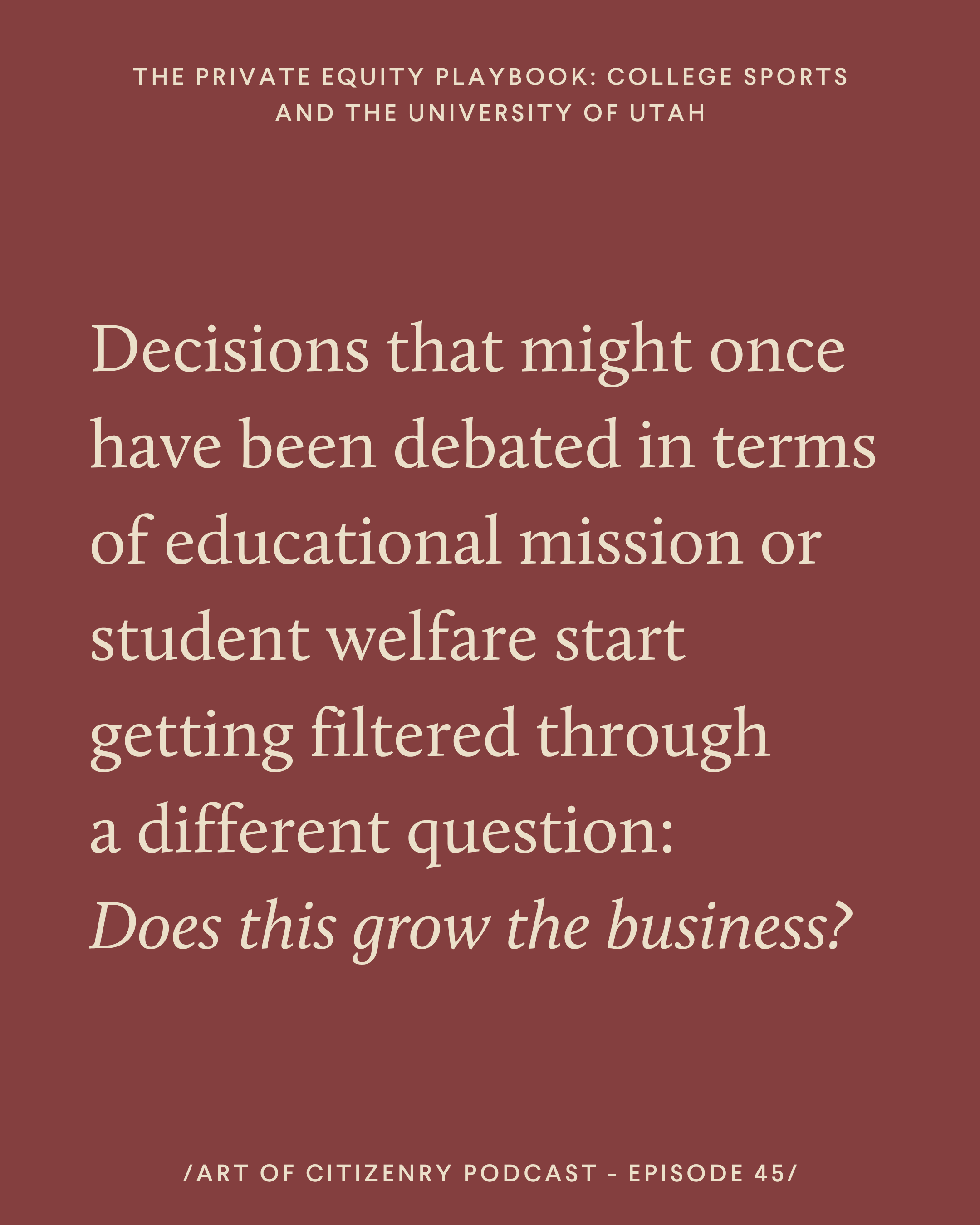
Private equity investment introduces a return-on-investment framework into athletic decision-making. With the sports generating the most revenue for colleges being football and men's basketball, this creates a structural risk for every other program.
At the University of Utah alone, there are 18 athletic programs beyond football and basketball. Sports like gymnastics, women's basketball, track and field, and swimming may not generate significant broadcast or sponsorship revenue, but they offer great value to the social mission of the institution itself. The Sling published a must-read analysis on this!
Title IX prohibits sex-based discrimination in college sports and requires schools to provide equal athletic opportunities to male and female athletes. But as private equity logic filters into decisions about which programs to fund and grow, sports economists warn that the pressure to optimize for revenue could erode equitable resource distribution.
Related Listens
Art of Citizenry Episode 41: The Private Equity Playbook — JOANN Fabrics
Art of Citizenry Episode 39: The Private Equity Playbook – Philz Coffee
Art of Citizenry Episode 34: Big Beautiful Bill – How Private Equity is Profiting from Immigrant Detention
Art of Citizenry Episode 27: The Growing Role of Private Equity in Fashion
Select Articles Referenced in this Episode:
Can Private Equity Save Athletics at the University of Utah? - The Sling
What the NCAA Settlement Means for Colleges and State Legislatures — National Conference of State Legislatures
5 things to know about Otro Capital, the private equity firm set to reshape Utah Utes athletics — The Salt Lake Tribune
Utah, Washington Propose Bills to Keep PE Out of College Sports — PitchBook
University of Utah Approves Private Equity Partnership for Athletics Programs — Sports Litigation Alert
Big Ten Reportedly Discussing $2B Private Capital Deal — Bleacher Report
Otro Capital Closes $1.2B Debut Fund — Sports Business Journal
Support the Podcast
Art of Citizenry is 100% listener-supported. Every contribution helps us continue producing research-intensive episodes and paying our small but mighty team. If this episode resonates with you, consider supporting our work:
💸 One-time contribution: Paypal
✍️ Subscribe to us on Substack & upgrade your account to paid
💌 Monthly support: Patreon
Thank You for Listening
Please subscribe and leave a five-star review for Art of Citizenry wherever you listen to podcasts. Also, follow along and share your thoughts on Substack - artofcitizenry.substack.com.