
Episode 37: Tariffs, Trade Wars, and the Future of Fair Trade
October marks both Fair Trade Month and National Co-op Month – a fitting moment to examine how global trade policies are reshaping the landscape for ethical businesses.
In this episode of Art of Citizenry Podcast, host Manpreet Kaur Kalra is joined by Nicole Vitello, Vice President at Equal Exchange, a worker-owned co-operative with the mission to build long-term fair trade partnerships that are economically just and environmentally sound.
Together, they unpack how tariffs, trade wars, volatile commodity markets, and climate pressures are colliding to threaten the survival of ethical supply chains.
From a 39% tariff on Switzerland to 50% tariffs on Brazil and India, industries ranging from chocolate and coffee to fashion are under immense strain. For fair trade, ethical businesses and co-ops, it’s not just about surviving the current administration’s tariff strategy – it’s about whether ethical supply chains can survive in a system tilted toward multinationals and shareholder profits. While these taxes are marketed as efforts to “bring manufacturing home,” the real impact lands on those least able to absorb the cost – smallholder farmers, small businesses here domestically, and ultimately consumers.
In this episode of Art of Citizenry Podcast, we explore:
How the trade wars, increases in tariffs, and high commodity prices are destabilizing ethical, sustainable, and fair trade supply chains – causing cost and pricing spikes from farmers to consumers
Why ethical businesses and co-ops are uniquely vulnerable under protectionist trade policies
How climate change, tariffs, and inflation are compounding global price volatility and putting financial pressure on farmer coops
The impacts of USAID cuts on economic development programs
Why cooperative business models and consumer solidarity may be the last line of defense against exploitative trade
🎧 Ethical supply chains that center fairness and sustainability remain the exception, not the rule. Tune in as we examine the human cost of tariffs and the structural inequities baked into modern capitalism and global trade systems.
Meet the Guest

Nicole Vitello, Vice President at Equal Exchange
After studying International Development at American University, Nicole worked with small farmers in Senegal, West Africa where she learned firsthand the value of the cooperative model for organic production and export. In 2008, Nicole joined Equal Exchange as a sales rep inspired by the economic model of trading directly with small farmers internationally. In 2011, Nicole became president of Oke USA, the fresh produce subsidiary of Equal Exchange trading organic fair trade bananas from Ecuador and Peru and avocados from Mexico. Nicole rejoined the Equal Exchange leadership team in 2023 as a Vice President and is proud to continue promoting the connection between small farmers in Central and South America and consumers in the United States and expanding the Equal Exchange Capital Model.
Equal Exchange sources and sells fair-trade coffee, chocolate, tea, bananas, and so much more — operating under a cooperative model that connects producer co-ops abroad with consumer co-ops and independent retailers across the U.S.
From Fair Trade to Worker Owned Coops: Why Ethical Business Models Matter
Go beyond the label. Ethical business practices should be considered more than a market distinction and instead should serve as a safeguard against the unchecked reach of hyper-capitalism. As the current administration doubles down on protectionist and profit-driven policies, supporting small businesses and those committed to building fair, ethical supply chains has never been more urgent. Challenging an economic system built on exploitative business practices, these enterprises already operate on thin margins – prioritizing living wages and dignified working conditions while balancing what consumers can reasonably afford. Ethical supply chains that center fairness and sustainability remain the exception, not the rule — largely because the system itself is not designed to support equitable trade.
“We can’t afford to lose more small independent businesses; they’re the backbone of an economy rooted in care and accountability.” — Nicole Vitello
Tariffs and Human Rights in Global Supply Chains
As mentioned in Episode 24, on the human cost of global supply chains, the recent wave of tariffs imposed by the current U.S. administration is not merely a matter of supply chain sustainability—it raises urgent human rights concerns, as these trade policies risk deepening labor exploitation and obscuring accountability across already fragile global supply chains.
When tariffs are raised, companies often respond by shifting production to jurisdictions or factories with even weaker labor protections or by cutting costs, creating an environment that further allows for the undermining of worker rights, such as reducing wages, increasing hours, or sidestepping safety protocols. These pressures exacerbate exploitative conditions, including forced labor and child labor, especially in sectors like agriculture, garment, and electronics.
This sourcing strategy is not new; rather, it has long been a driving force behind how corporations operate in their race to the bottom, prioritizing profit over human rights. Countries hit hard by the tariff hikes face high U.S. trade deficits precisely because U.S. corporations have outsourced production there to take advantage of weak labor standards and extremely low wages. The race to the bottom is not new and it continues to mean transparency and due diligence are secondary priorities, further obscuring human rights violations.
Supporting More Just and Fair Trade
Worker-led movements, co-operatives, and fair trade networks offer an opportunity for us to reimagine the exploitative impacts of globalization by centering dignity, democracy, and shared prosperity in the global economy. These systems connect farmers, workers, and consumers through mutual accountability rather than extraction. Preserving them means protecting the very infrastructure that allows ethical businesses to exist in an era where fairness is increasingly under siege.
“If we lose fair and transparent supply chains, we don’t just lose products—we lose the farmers and communities behind them.”
— Nicole Vitello
To ensure we can continue to strive towards a fairer global trade model, consumers and communities must actively participate in its ecosystem by supporting goods and co-ops that prioritize people over profit.
A Worker Owned Coop Model
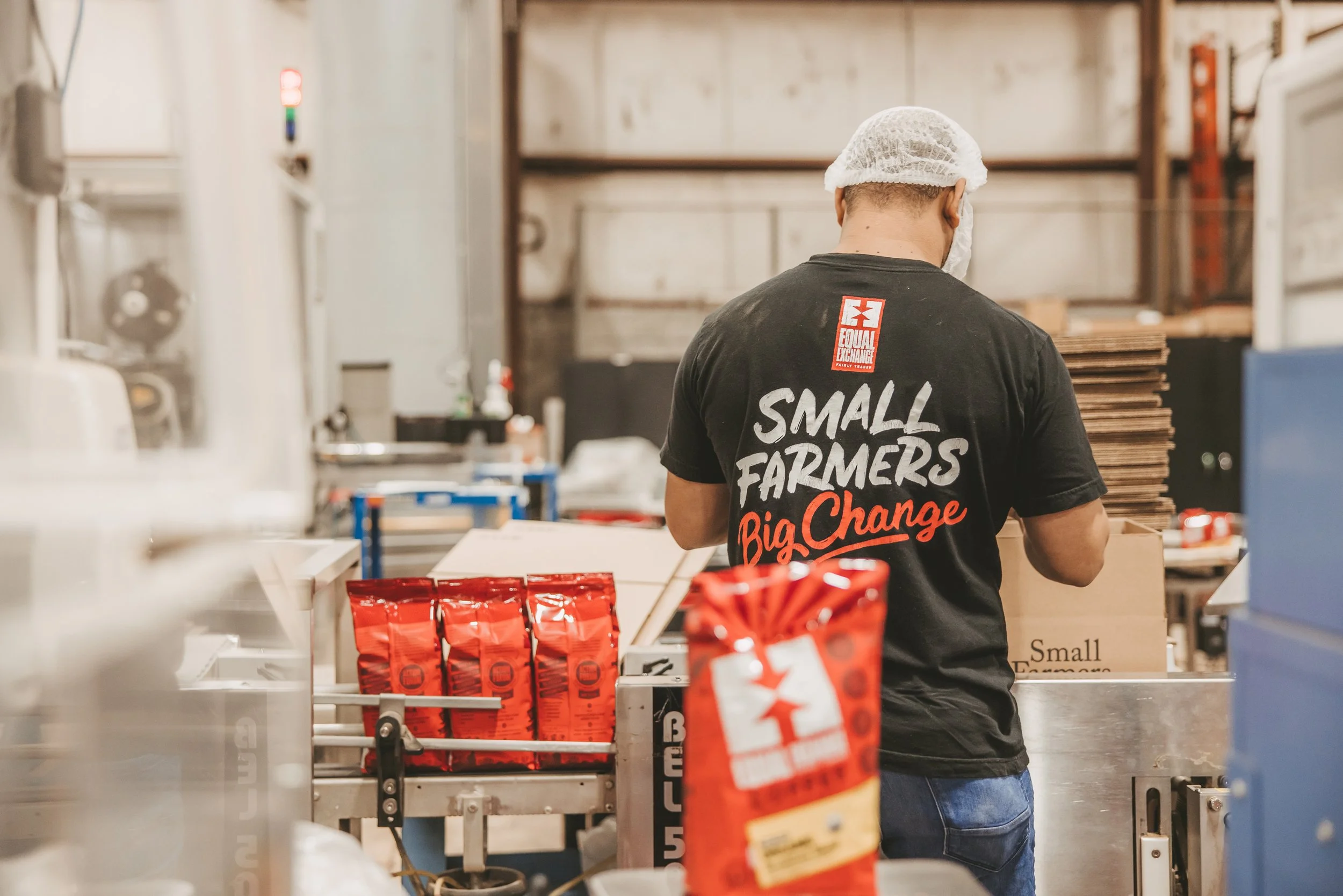
Image courtesy of Equal Exchange
Equal Exchange is a worker owned coop has been trading directly and fairly with small farmer coops for 40 years. An alternative business model based on democratic principles, each worker-owner gets one vote, has access to shared financial information, and invests an equal share in the business. In contrast to the national trend of growing income inequality, we have a 5:1 top-to-bottom pay ratio, plus excess profit distribution shared equally among worker-owners at the end of each year.
“Co-ops aren’t a relic of the past—they’re a model for the future, more relevant now than ever.”
— Nicole Vitello
Equal Exchange imports organic fairly traded coffee, tea, cocoa, bananas and more directly from over 40 small farmer organizations around the world. We partner with farmer cooperatives who are democratically organized, sharing resources and decision-making among their members. Collectively, they gain crucial market access and decide how to invest fair trade and organic premiums in their communities. Our longstanding relationships allow us to secure the best crops, while continuing to develop innovative programs in collaboration with the co-ops, from crop diversification to quality trainings to women's leadership development.
How Equal Exchange is Contextualizing the Impacts of Tariffs and High Commodity Prices
A note from our guest: “The current combination of high commodity prices for coffee plus tariffs is causing cost and pricing spikes from farmers to consumers. While price increases to farmers are needed for the industry to catch up with increased costs, volatility in pricing puts financial pressure on farmer coops who do the purchasing and the exporting to Equal Exchange. They are forced to float additional capital for inventory purchasing and if the price drops they are left exposed financially. Volatility and capital needs can make or break small to medium sized businesses and strain sustainable and fair pricing models like fair trade. Equal Exchange shares this burden by pre-harvest financing, stable contracts and direct price negotiations which means putting our capital model to work for farmers and their export associations.”
Stay Informed, Get Involved
Support small farmers and the cooperative economy:
💸 Donate to Equal Exchange’s Small Farmer Fund, created to replace the $4.5 million in lost USAID funding: shop.equalexchange.coop/products/donate
Read more about the funding cuts and their impact: info.equalexchange.coop/articles/lost-usaid-funding
Find your nearest National Co+op Grocers member store
🗳️ Advocate for policies that strengthen corporate accountability for environmental and human rights impacts within supply chains.
☕ Go beyond the label (and look beyond certifications – more about this in a past conversation here) Learn more about the sourcing practices of businesses you support. Greenwashing, fair-washing, etc. have become a common marketing tool. Don’t just look for labels, research the brands you support and understand how they are considering people and the planet in their approach to business. Choose products from businesses that pay farmers fairly and build long-term community resilience.
Keep asking questions. Here are some additional resources to dig into and articles we reference in this conversation:
NY Times: Coffee Prices Are at a 50-Year High. Producers Aren’t Celebrating
The Atlantic: The Drink That Americans Won’t Give Up Without a Fight — learn more about how this affects you, and what’s at stake (it’s coffee. Coffee’s at stake).
Average prices for Arabica and robusta coffee worldwide from 2014 to 2026
Support the Podcast
Art of Citizenry is 100% listener-supported. Every contribution helps us continue producing research-intensive episodes and paying our small but mighty team. If this episode resonates with you, consider supporting our work:
💸 One-time contribution: Paypal
💌 Monthly support: Patreon
✍️ Subscribe to us on Substack & upgrade your account to paid
Thank You for Listening
Please subscribe and leave a five-star review for Art of Citizenry wherever you listen to podcasts. Also, follow along and share your thoughts on Substack - artofcitizenry.substack.com.